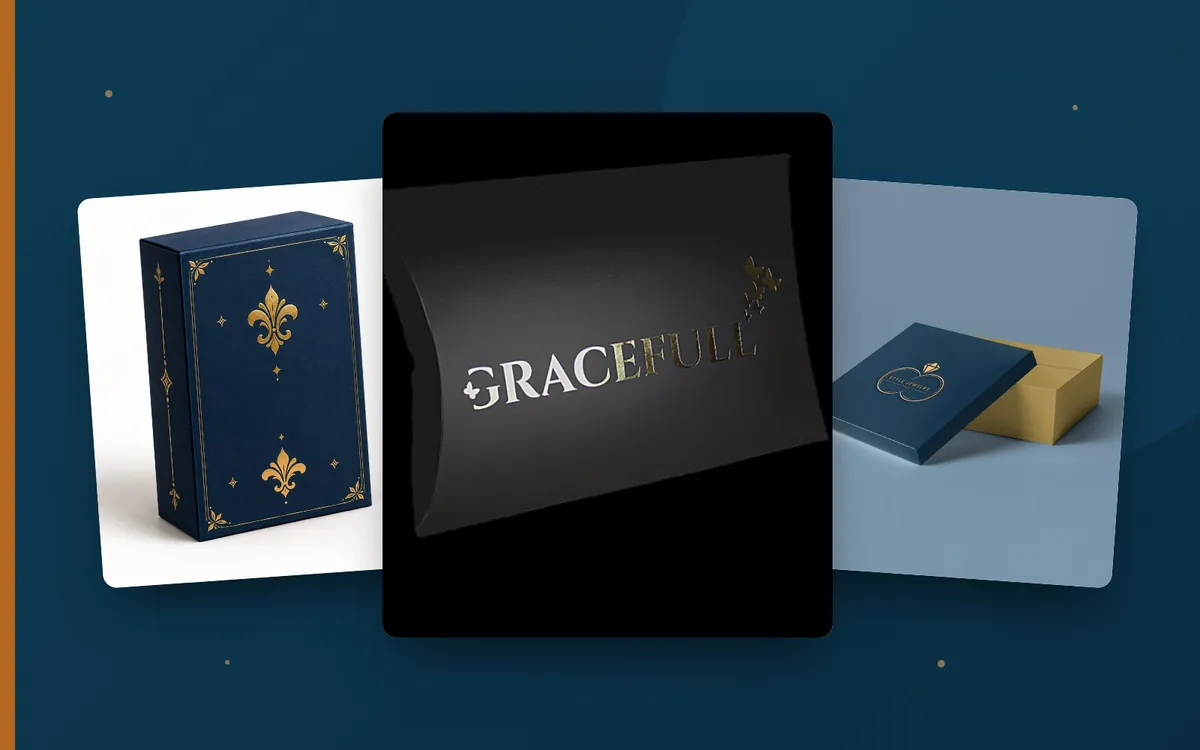
A gold logo that sparkles in the light, or silver lettering on matt black board: hot foil stamping is one of the most effective finishes for packaging. It instantly gives products a premium, often festive character. Here is how the process works and when it pays off.
How hot foil stamping works
In hot foil stamping, a heated stamping die is pressed with high pressure onto a foil and the board beneath it. Heat and pressure release the colour or metal layer from the carrier film. Where the design is, it bonds permanently to the material. The result is a shiny, very precise surface with a true metallic effect. Normal printing cannot achieve this effect.
What foils are available?
- Metallic: gold, silver, copper, rose gold or bronze, in gloss or matt
- Coloured foils: for example red, blue or black, gloss or matt
- Holographic foils: with rainbow or pattern effects, eye-catching and modern
- Pigment foils: opaque, non-metallic colours, such as white on dark board
The benefits
- True metallic shine: far more brilliant than metallic inks in printing
- High perceived value: customers associate gold and silver effects with quality and exclusivity.
- Precision: even fine type and lines are reproduced sharply.
- Opacity: works on dark or coloured backgrounds too
- Combinable: with embossing, soft-touch or UV coating
Combining hot foil and embossing
The combination of hot foil and embossing looks especially elegant. The design shines and is raised at the same time, so you can feel it. Read more about embossing in our article Raised varnish and embossing.
Hot foil or cold foil?
Besides hot foil, there is cold foil. Here the foil is applied with adhesive directly in the printing press and can then be overprinted. This creates metallic shades in many variations. Cold foil is economical mainly for large runs. Hot foil, on the other hand, usually offers a more intense shine. It also suits textured materials and combines well with embossing.
Applications
Tips for your print data
- Set up foil areas as vector graphics on a separate layer or as a separate spot colour.
- Avoid extremely fine lines and very small type. We will gladly advise you on the minimum thickness.
- Plan foil accents carefully. A foiled logo often has more impact than large foil areas.
Sustainability
Use foil selectively. Small accent areas affect the recyclability of cardboard packaging far less than large foiled surfaces. And they often look even more elegant.
Would you like to give your packaging a special shine with hot foil? We will advise you on foil, material and combinations and send you a binding quote within 24 hours. For an overview of other finishes, see our article Special surface finishes.
Request a quote →