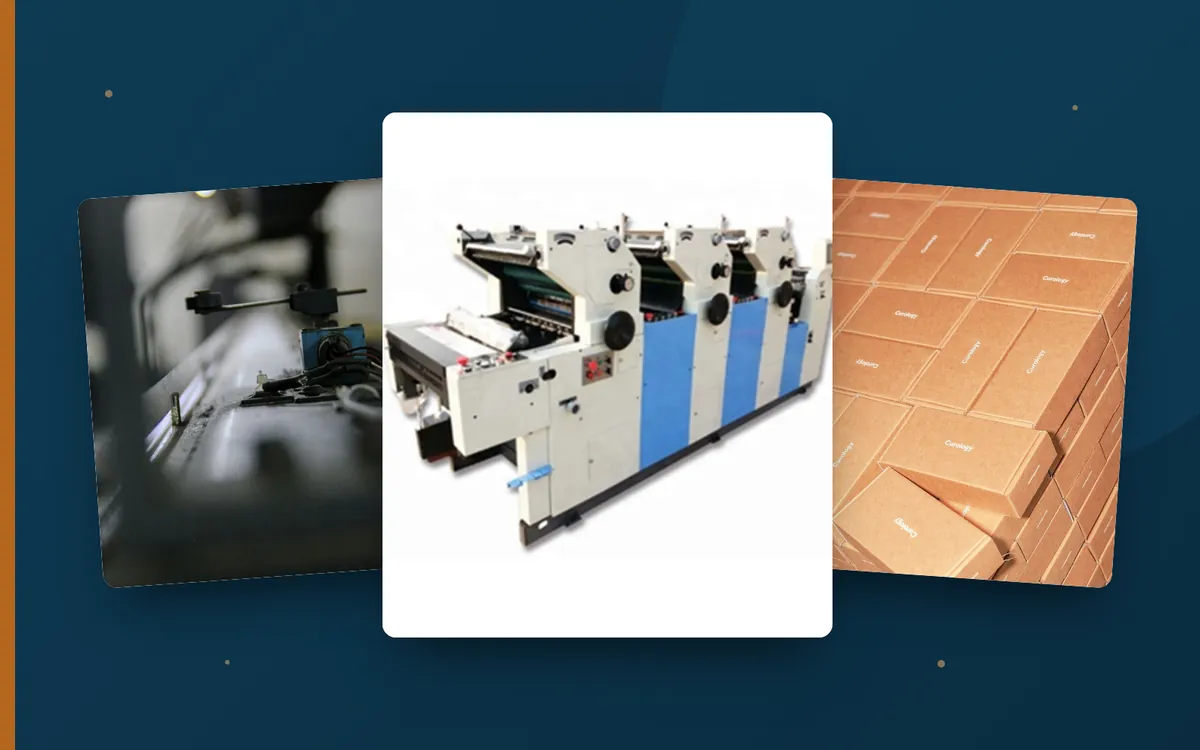
You send a PDF file, and a few weeks later pallets of finished packaging are at your door. What happens in between? Here we show the production process step by step, using a printed folding carton as an example.
1. Data check
First, your print file is checked. Are format, bleed, resolution, colour space and fonts correct? Does the design fit the die line exactly? Are finishing areas set up correctly? Errors are caught here before they become expensive. We carry out this print data check free of charge.
2. Imposition
A folding carton is small, a print sheet is large. During imposition, as many blanks as possible are therefore arranged efficiently on one sheet. A good layout saves material and costs.
3. Proof and approval
A colour-accurate proof shows how the colours will look in print. Your approval clears the way for production. Read more about colour control in our article What role does colour accuracy play in printing?.
4. Printing plates
For offset printing, a printing plate is imaged for each ink colour. With digital printing, this step is skipped, because the data goes straight to the press. Our article Offset or digital printing explains when each process makes sense.
5. Printing
The press is set up, and colours and registration are adjusted. Once the first proof sheet is approved, the entire run is printed. Colours are measured regularly so that the last sheet looks exactly like the first.
6. Finishing
Depending on the job, varnish, film lamination, hot foil or embossing follow. Some varnishes are applied directly in the press, other finishes in separate steps. Our article Special surface finishes gives an overview.
7. Die-cutting and creasing
A cutting die cuts the blanks out of the sheet exactly along the die line. At the same time, crease lines are pressed in so that the board folds cleanly later. Precision is crucial here, because print and cut must match exactly.
8. Stripping
After die-cutting, the blanks are separated from the waste skeleton. The board scraps go to recycling.
9. Gluing
In the folder-gluer, the blanks are pre-folded and glued at the glue flap. Depending on the style, this creates a simple tuck-in base or a crash-lock base. The finished boxes lie flat, ready to be erected.
10. Inspection, packing and shipping
Finally, the goods are inspected, counted, packed in boxes and palletised. Then they are on their way to you. Read more about quality assurance in our article Quality control in the printing and packaging industry.
The advantage: everything from one source
When printing, die-cutting and gluing take place in the same plant, there are no handovers between different suppliers. This saves time, reduces sources of error and allows continuous control. With us, everything happens under one roof: from prepress through printing and finishing to final assembly.
Our article How is custom packaging made? describes the process from the customer’s point of view, from enquiry to delivery. You will receive a binding quote within 24 hours.
Request a quote →